
A Very Sound Midterm Forecast
The Economist believes that Democrats have a nine-in-ten chance of winning the House.

A few weeks ago, The Economist published their forecast for 2026 midterm elections.
With the possible exception of Nate Silver’s forecast over at Silver Bulletin, The Economist runs one of the most methodologically serious election models out there. It debuted in 2018 and has consistently produced strong results since. I’d call it the most reliable published forecast, to date,1 for the 2026 midterms.
I have a few qualms I note below, but my personal rule of thumb is2 to rely on it unless I can clearly explain why I disagree with a specific prediction.
The model lists separate results for the House and the Senate. In this post, I’ll walk you through the headline results for each.
The House
In the very first line of the forecast write-up, The Economist comments
The sun rises in the east; the other queue always moves faster; and the president’s party loses the House of Representatives in the midterms.
It’s an apt metaphor. They currently give Democrats a nine-in-ten chance of flipping the House.
This is a surprisingly confident prediction, significantly higher than Polymarket’s 78%, and they list three reasons for this confidence:
Individual races tend to cancel out across hundreds of concurrent elections.
The House usually tracks the generic ballot survey, which Democrats currently lead by six points.
Undecideds tend to break for the challenger and against the president’s party.
I haven’t dug into House elections, but it’s reasonable to think of them in terms of many uncorrelated results. If you flip 10 coins, each one individually could come up tails, but the odds of all landing tails are quite low. That’s the key intuition explaining why Democrats are in such a strong position. There would need to be a fairly systematic shift in favor of Republicans, or a very large polling error (~6 points, nearly twice that of 2024), and neither is likely to happen.
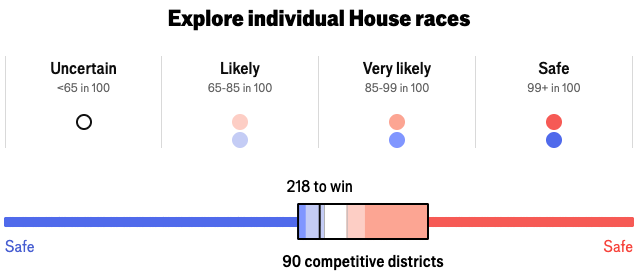
Additionally, secondary metrics also favor Democrats. They’ve been performing well in special elections, presidential approval is 17 points underwater,3 and gas prices are through the roof.
Ultimately though, there’s a simple principle at play: The president’s party truly does tend to lose the House of Representatives in the midterms. It takes special circumstances to defy that raw gravitational force.
Is Gerrymandering a Special Circumstance?
There’s been a lot of ruckus about gerrymandering lately. Some states (both Republican and Democratic) have redrawn their congressional maps.4
It initially seemed to have been fought to a draw, but after Virginia’s new map was overturned the advantage shifted back to the GOP. This resulted in a notable uptick in The Economist’s House forecast (R used to hover around 5% but has since gone up to 10%).
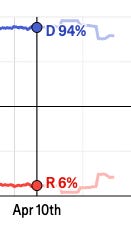
Still, this isn’t a huge change, and there aren’t that many opportunities remaining to change the map this cycle. A few options remain for Democrats, and Republicans are facing strong national headwinds. It’s certainly something to keep an eye on, but my guess is that this will matter more for the House election of 2028.
The Senate
Currently, The Economist gives Republicans a 51% chance of keeping the Senate and Democrats a 49% chance of flipping it.
To say this clearly: this is a coin flip.
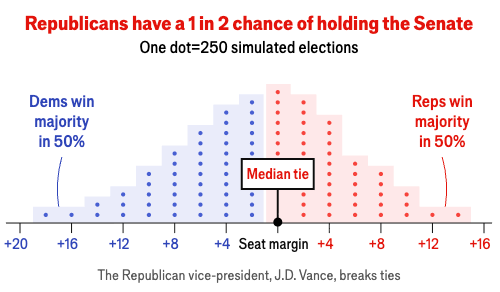
Anything in the 45-55 range, in either direction, I read as a one-in-two chance. It’s easy to look at a number and say “oh my god, party X is favored,” which makes for excellent clickbait, but these numbers are too noisy to view them as anything other than a coin flip.5
On the individual races:
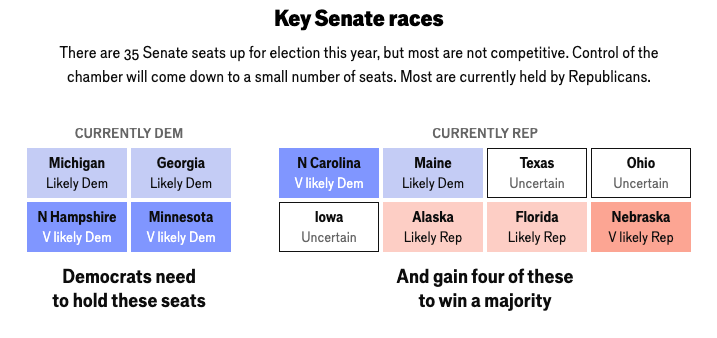
This aligns reasonably well with my Senate article from last month. A few details:6
They agree Democrats are likely to successfully defend all of their current seats: Michigan (22/78%), Georgia (18/82%), New Hampshire (13/87%), and Minnesota (9/91%).
They believe Democrats are likely to flip North Carolina (8/92%) and Maine (22/78%).
They rate Texas (61/39%), Ohio (61/38%), and Iowa (64/36%) as toss-ups.
They rate Alaska (68/32%) and Florida (71/29%) as likely to remain Republican.
And while they list Nebraska as a “key race,” they give Independent Dan Osborn a very low chance (88/12%) of claiming the seat.7
My Thoughts
While I deeply respect The Economist’s work, I do have a few notes.
Candidate Quality Matters
I think they aren’t giving quite enough weight to the quality of individual candidates. Three individuals running in those Senate races—Susan Collins (R) from Maine, Mary Peltola (D) from Alaska, and Dan Osborn (I) from Nebraska—have quite dramatically outperformed the baseline partisanship of their state.
Osborn is an especially clear example. Trump won Nebraska by 20 points in 2024, but Osborn only lost by seven, and while I agree his chances are small it looks like they are using the presidential baseline in that race (they use a voting history score of R+17 for this race). Another item that makes me pause is how they priced Lindsey Graham’s chances of winning in South Carolina (81/19%) as lower than Osborn’s opponent (88/12%). I think their methodology undervalues candidates with a track record of major over-performance.
I’d give Collins, Peltola, and Osborn better odds than the ones listed above.
What they aren’t accounting for
They also don’t account8 for a handful of external factors. They assume the map is set and don’t consider the chance of additional gerrymandering (this is why Virginia’s ruling created such a sharp change).
They also explicitly aren’t considering other mechanical changes to the election. I’m not going to speculate on that here, but I’ll note that they’ve written a handful of articles about this possibility.
Finally, I’ll note that The Economist tends to make strong predictions. When they first published this model, it gave Democrats a 95% chance of winning the House. The model had previously peaked at 98%, which is frankly overconfident for a race that’s six months out. The gravity of opposition midterms is fierce, and 90% might be reasonable, but it’s worth remembering that a lot of time remains before voters reach the booths.
Other Midterm Notes:
Talarico (TX, D) got a very promising poll out of YouGov in Texas. It’s enough for me to begin thinking of the seat as a toss-up.
Peltola (AK, D) had another promising poll, but it’s worth highlighting that she maintains only a slim edge when compared against the sum of Republican candidates in the race (50.2% vs 49.8%).
Mike Rogers (MI, R) has emerged as a clear frontrunner in the Republican primary for the Michigan senate race and had a handful of strong head-to-head polls against the Democratic primary field. I may keep an eye on this race as the field consolidates.
The date being May 17th, 2026.
At least until the SB forecast is released.
I think people should be careful of over-claiming when discussing Trump’s rating. He has a remarkably robust floor of ~38% approval; claims like “Trump’s approval is collapsing!” almost never mention this. Many people still support him.
It is also true that he remains 17 points underwater and this is, objectively, an unpopular rating.
And other states have resisted pressure to do the same.
I’d start saying there’s a meaningful advantage around the 60/40 threshold.
Note that probabilities are listed as (R/D%).
They actually list Kansas (78/22%), South Carolina (81/19%), and Montana (83/17%) as less safe than Nebraska (88/12%) for the GOP.
In fairness, they clearly disclaim that they don’t account for these items.